One system for the whole company

Your company runs on nine tabs.
It should run on one.

A CRM here, an invoicing tool there, attendance in one sheet, leave in another, salaries in a third. Spyne replaces the lot with a single record — so a client is typed in once, payroll comes out of the month that actually happened, and you can finally see which work made money.

30 days free · No card needed · One flat price for the company, not per user · Live before lunch

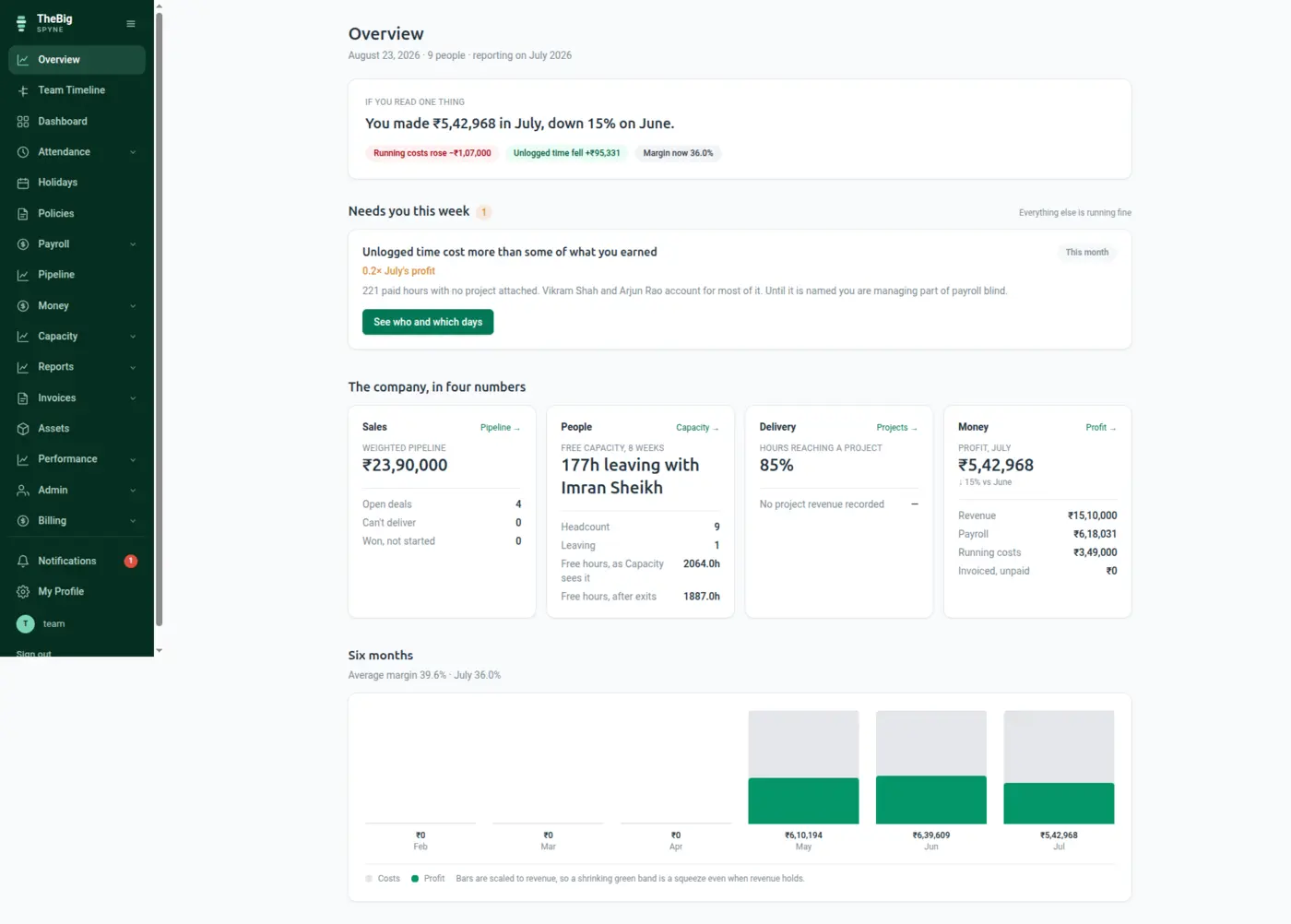
The company overview dashboard with profit, pipeline, capacity and what needs attention
The owner's overview. One sentence at the top, then what needs deciding.
6 → 1Subscriptions a ten-person company usually collapses into one
₹399$19A month for the whole company — not per seat, every feature included
5–50 peopleThe size where spreadsheets stop being honest
Same dayImport, invite the team, and run a month in parallel with your sheet
Sound familiar

Six sentences you have said out loud this year.

None of them are feature requests. They are all the same problem wearing different clothes: the answer needs two numbers that live in two different tools.

"It's the 30th. Payroll is going to take two evenings."

Attendance gets counted by hand, cross-checked against a leave sheet and copied into a salary file. The work produces nothing new — it exists only because the numbers are in three places.

Paid days come straight from attendance, deductions run as rules, and the month is a review rather than a rebuild. Onboarding to exit →

"Why is my casual leave 6.25 days?"

Somebody edited a row in March, somebody adjusted a figure in June, and the formula got dragged over a merged cell. The number might be right. Nobody can show that it is.

The balance is the sum of an append-only ledger — every accrual, approval and adjustment with a date and a reason on it. Leave & balances →

"I was in on the 14th."

The sheet says otherwise, and there is no evidence either way, because the record was typed in later by the person being asked about it. Now the argument is about the spreadsheet.

Every punch carries an IP captured server-side and a timestamp, and every admin correction keeps who, when, why and the value before. Attendance →

"Can you send this client's invoice? Their GST number is… somewhere."

It is in the CRM, or the last invoice, or an email. It gets re-typed, and re-typed is where the wrong digit comes from — on a document that is a tax record.

The client is created once with the deal. Every invoice after it reuses the address, GSTIN and place of supply, and the numbering is issued by the system. CRM to invoice →

"Everyone's flat out and revenue looks fine. So why is the bank balance like this?"

Because nothing joins the salaries to the hours. Cost is a rate card somebody set two years ago, so the margin report has been wrong for four quarters and nobody could tell.

Cost comes from the payslips you actually issued, divided by the hours logged to each project. No rate card, so nothing drifts. Plan to profit →

"Did anyone get the laptop back from her?"

She left five weeks ago. The offboarding checklist was in somebody's notes, the asset list has not been updated since 2024, and her email account is somehow still active.

The exit is a tracked checklist — handover, assets, access, final settlement — and it closes when the list closes. Exits & offboarding →
Flow one

From the first enquiry to the money in the bank.

The chain most small businesses run across four tools — and re-type the same client into every one of them.

A client should be typed in once. Not four times.

The enquiry goes into a CRM. The quote goes into a spreadsheet. The invoice goes into a billing tool. The margin goes nowhere at all, because joining those three is a weekend nobody has. In Spyne it is one record that moves forward on its own.

The enquiry arrives Before you quote It is won Time to bill Getting paid The question nobody can usually answer

Carries forwardEnquiry to margin without a single export, import or copy-paste between tools.

Walk the whole flow →

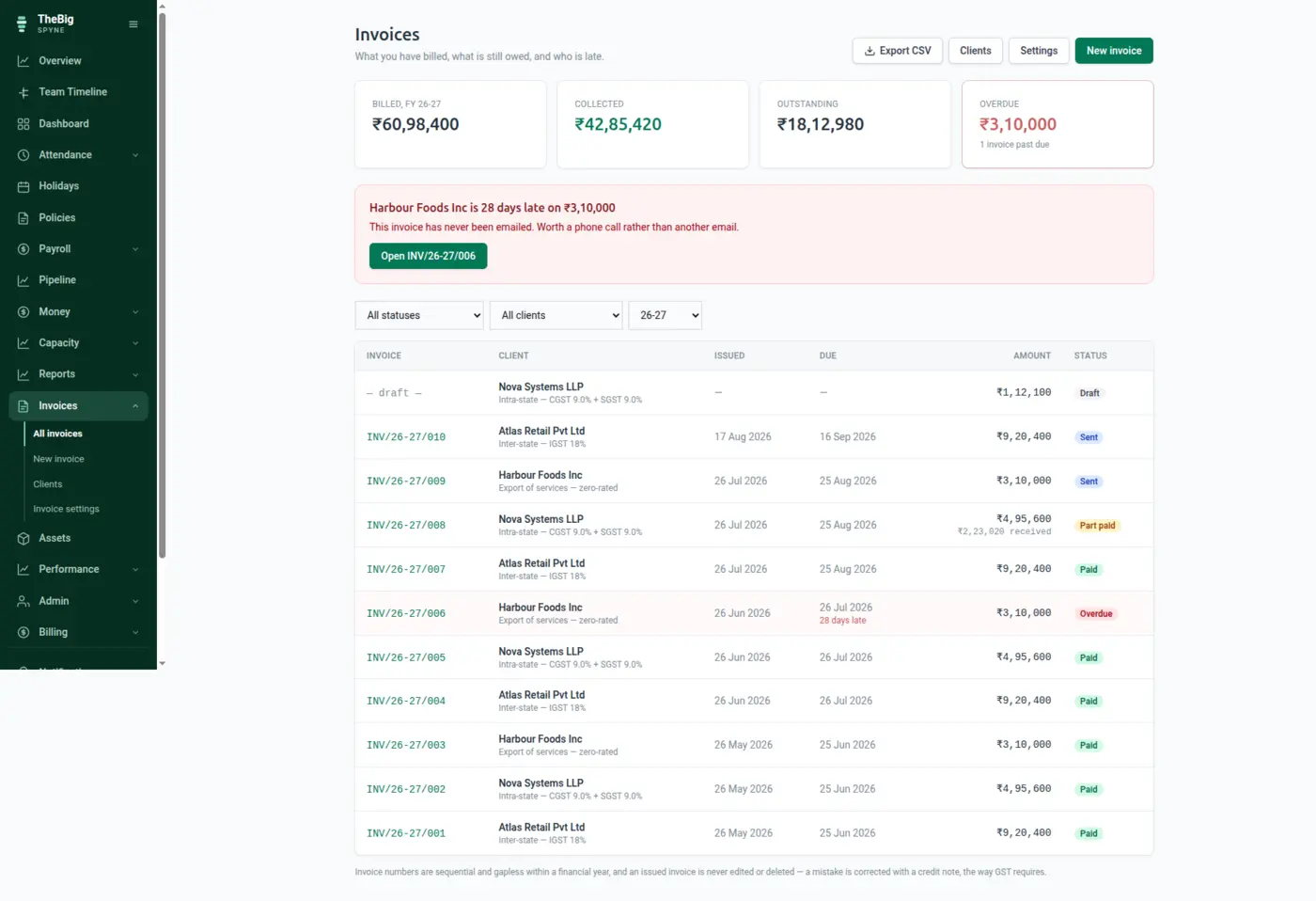
The invoice list showing issued, part-paid, paid and overdue invoices with amounts
Every invoice and its real state — paid, part paid, overdue, draft.
Flow two

From the offer letter to the final settlement.

One employee record for the whole employment, so the last day is a checklist rather than an archaeology project.

One employee record. From day one to the last day.

Somebody joins and gets added to five places. They work for two years across three more. They leave, and half of it is never closed — the laptop, the access, the leave encashment nobody can compute. Spyne keeps one record for the whole of that, and the end of it is a checklist rather than a memory test.

Day zero Every working day When they need time off Month end Through the year The last day

Carries forwardOne record for the whole employment. The last day is a checklist, not an archaeology project.

Walk the whole flow →

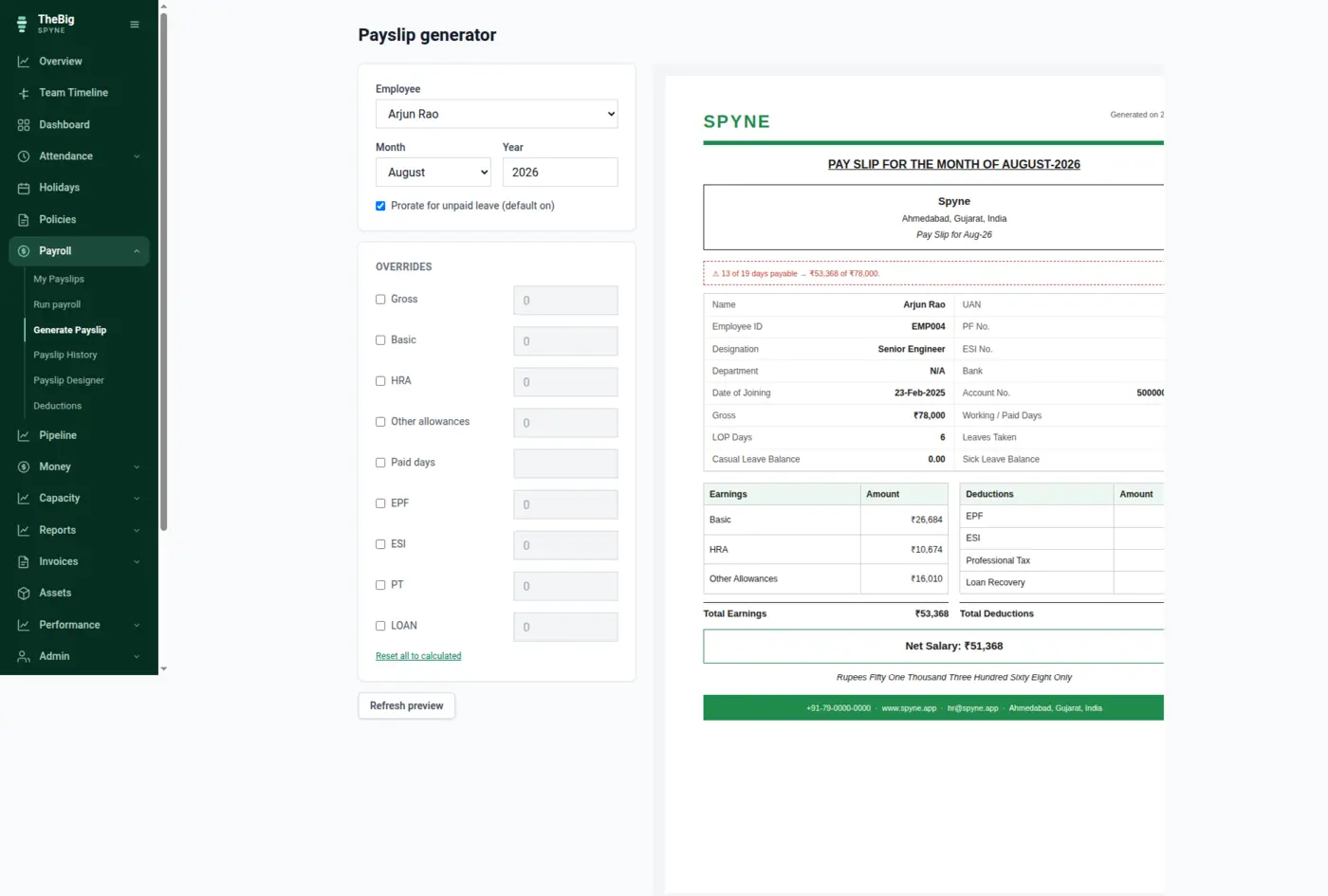
The payslip generator with employee and month selected, override fields, and a live payslip preview
The generator. Every figure is computed server-side; the browser only previews.
Why one system

The two flows are the same record. That is the whole product.

Six separate tools can each be excellent and still never answer this: the payslips at the end of the people flow are exactly what the money flow divides across projects. No export, no rate card, no reconciliation — which is why the answer exists at all.

The work you planned is the cost you paid.

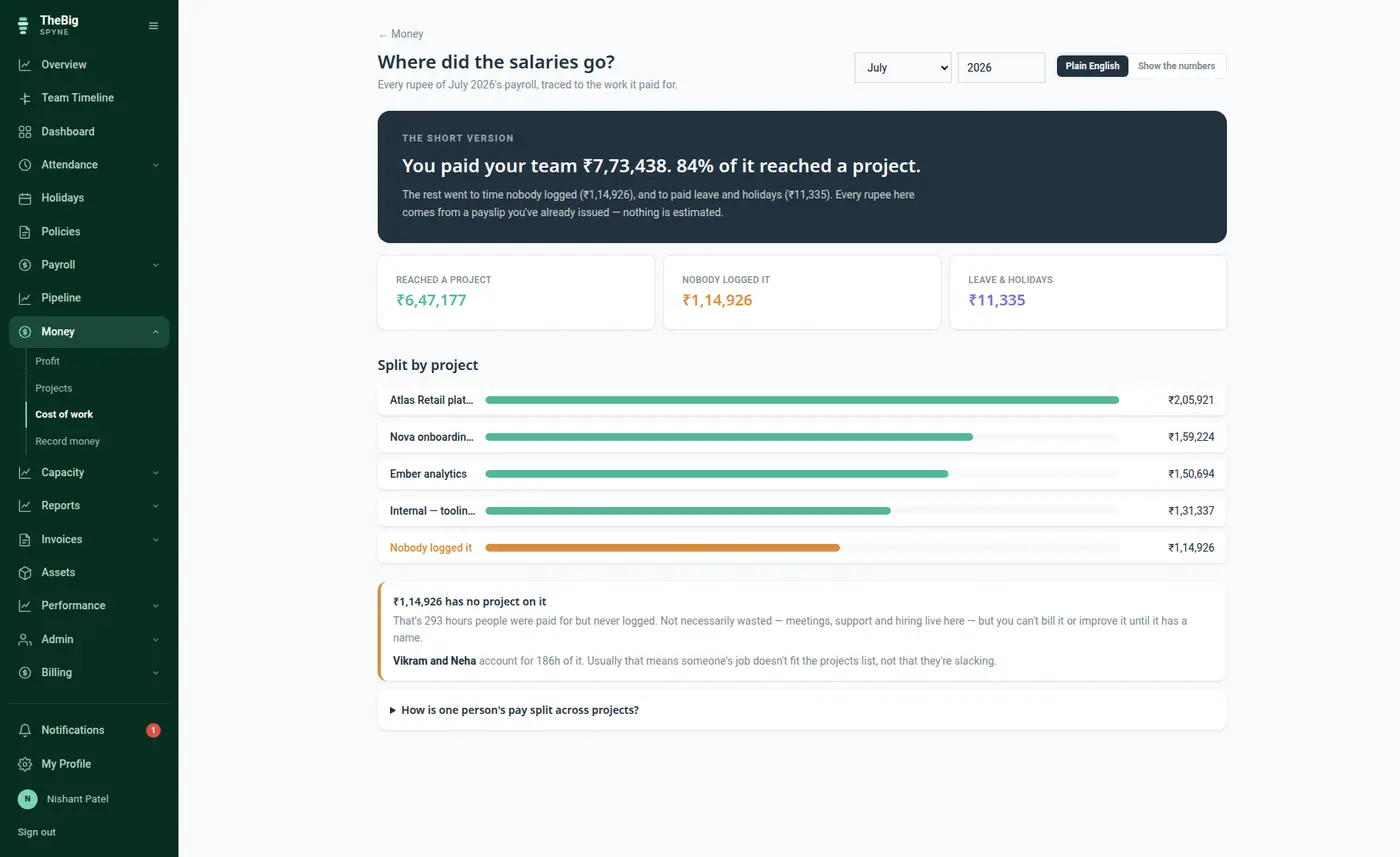
Every profitability tool asks you to maintain a rate card. It is wrong within a quarter, and then the margins are wrong too. Spyne has both ends of the chain already — the hours and the payroll — so the cost of a project is the money that actually left your bank account.

  • No rate card to maintain A raise changes the margins on its own, from the month it takes effect.
  • Unlogged hours stay unlogged Not quietly spread across projects — which is what makes other tools' margins look better than yours.
  • Issued payslips are frozen A raise next April cannot rewrite the March payslip somebody already downloaded.

Plan to profit, step by step →

Cost of work showing each person's real pay divided across the projects they logged hours to
Real payslips, real hours, and what nobody logged shown as unlogged rather than hidden.
Built for the AI era

The work got faster. The admin around it did not.

AI compressed a week of delivery into an afternoon. It did nothing for the four hours a week you lose moving the same client, the same person and the same month between six tools. That gap is now most of the overhead in a small business.

Plan in days, not fortnights

When a week of work fits in an afternoon, a fifteen-day plan is fiction by Tuesday. Spyne asks one question each morning: what ships today — and keeps the answer as a record.

Admin should be a by-product

Attendance, leave balances and payroll accumulate out of days that were already worked. Nobody re-enters anything for the system's benefit.

Small teams, serious answers

Margins per client, capacity before you quote, balances that explain themselves — the things that used to need a finance function. Why one system beats six →

Solutions

Pick the chain you want to fix first.

You do not have to move everything at once — most teams start with the flow that costs them the most evenings.

All 17 features, if you want the catalogue →

Pay less, get more

One bill for the company. Not one bill per seat, six times over.

Two plans, from ₹399$19 a month — every feature in both, priced by team size rather than per user. No modules to add on, no per-payslip charges, and no quote to wait for.

Getting started

Live before lunch.

Import and invite

Employees, clients and assets come in from CSV or Excel, each with a template. Add your holiday calendar and salary structures, and everyone lands on their own dashboard.

Run one month in parallel

Keep your sheet for a month and compare. If the two disagree, one of them is wrong — and that is a better test than any demo.

Close the other tabs

Add invoicing and delivery once the people side is settled. Every feature is in both plans, so nothing costs extra when you switch it on.

Questions

What people ask before they switch.

What does Spyne do?

Spyne runs the operational side of a small business on one record: sales pipeline and clients, GST invoicing and payments, attendance, leave, payroll, daily delivery and project profitability. It is one platform instead of the five or six separate tools most companies of five to fifty people are currently paying for.

How many tools does Spyne replace?

For a typical ten-person company: a CRM, an invoicing tool, an attendance register, a leave tracker, a payroll sheet and a project or time tracker — plus the asset list and the profitability spreadsheet nobody maintains. One login and one bill instead of six.

How much does it cost?

₹399 a month for the whole company up to 30 people, not per user. Every feature is included in every plan, there are no modules to add on and no per-payslip charges. Thirty days free with no card.

Can it handle Indian payroll and GST?

Yes. EPF, ESI and professional tax are configured as rules with your own caps, thresholds and state slabs, and payroll is computed from attendance rather than typed in. Invoices decide CGST and SGST against IGST from place of supply, and numbering is sequential and gapless.

How long does it take to set up?

Most teams are live the same day. Invite the team, import your holiday calendar and salary structures, and publish your first daily plan. Employees, clients and assets import from CSV or Excel, and one click fills a trial with realistic sample data so you can see every screen before entering your own.

Do we have to move everything at once?

No. Most teams start with attendance and leave for a month, add payroll once they trust the days, and bring delivery and invoicing across after. Nothing costs extra when you switch it on, because every feature is in both plans.

See it with data in it before you enter any of your own

Thirty days free, no card. One click fills the trial with a realistic sample company — three months of attendance, payroll, invoices and projects — so every screen has something in it from the first minute.