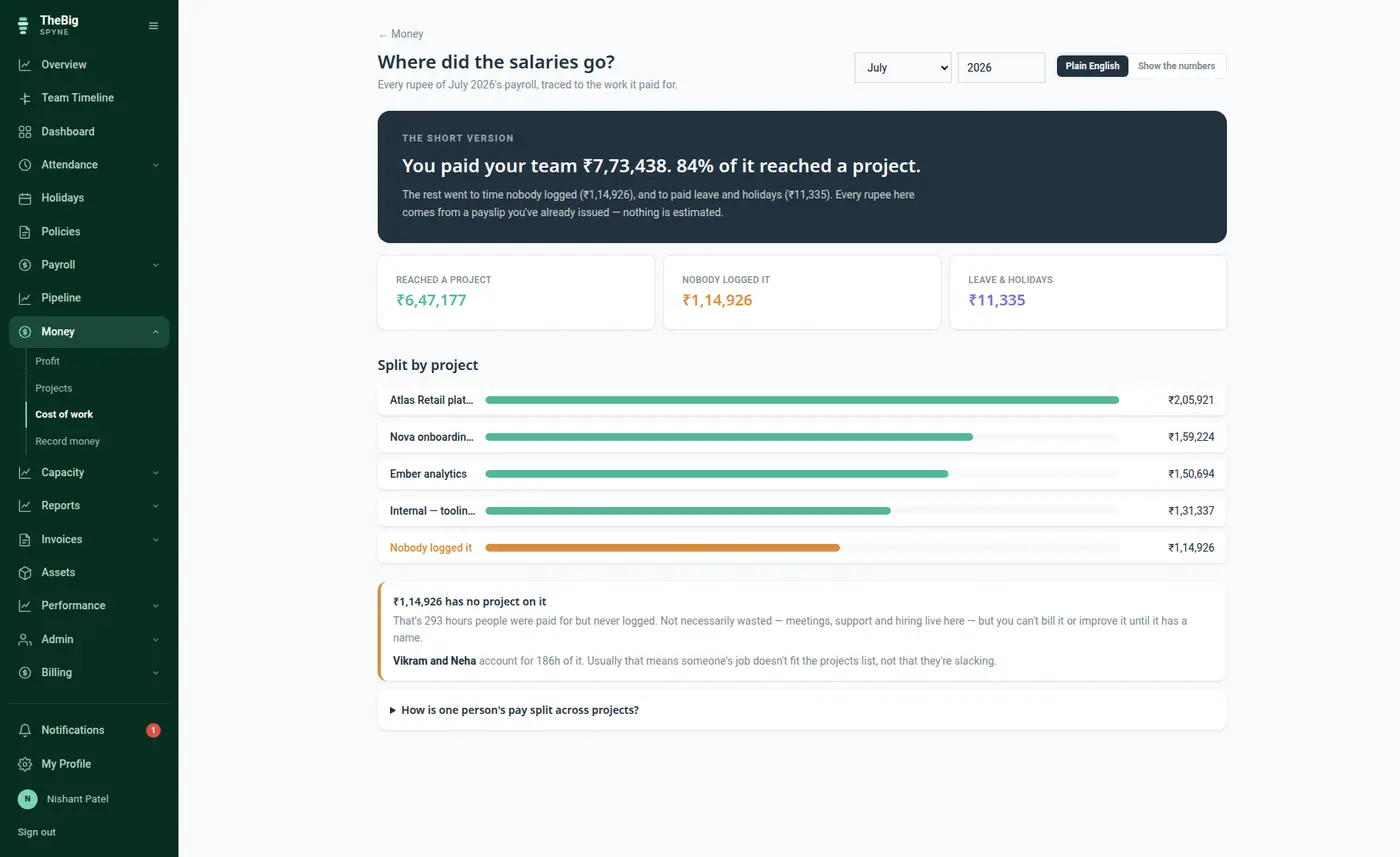
Every profitability tool asks you to maintain a rate card. It is wrong within a quarter, and then the margins are wrong too. Spyne has both ends of the chain already — the hours and the payroll — so the cost of a project is the money that actually left your bank account.
30 days free · No card needed · One click fills it with sample data so you can walk the whole flow before entering anything of your own
None of this is a missing feature. Every one of these tools works. The cost is the space between them — and it is paid in re-typing, in arguments, and in questions nobody can answer.
Follow it from the thing that starts it to the thing that finishes it. Watch what carries forward at each step — that hand-off is the whole difference.
Tasks with owners, estimates and the project they belong to. Published days stay as a permanent record, which is what makes "what did we actually do in March" a question with an answer.
Carries forwardEvery task knows its project, so every hour logged on it does too.
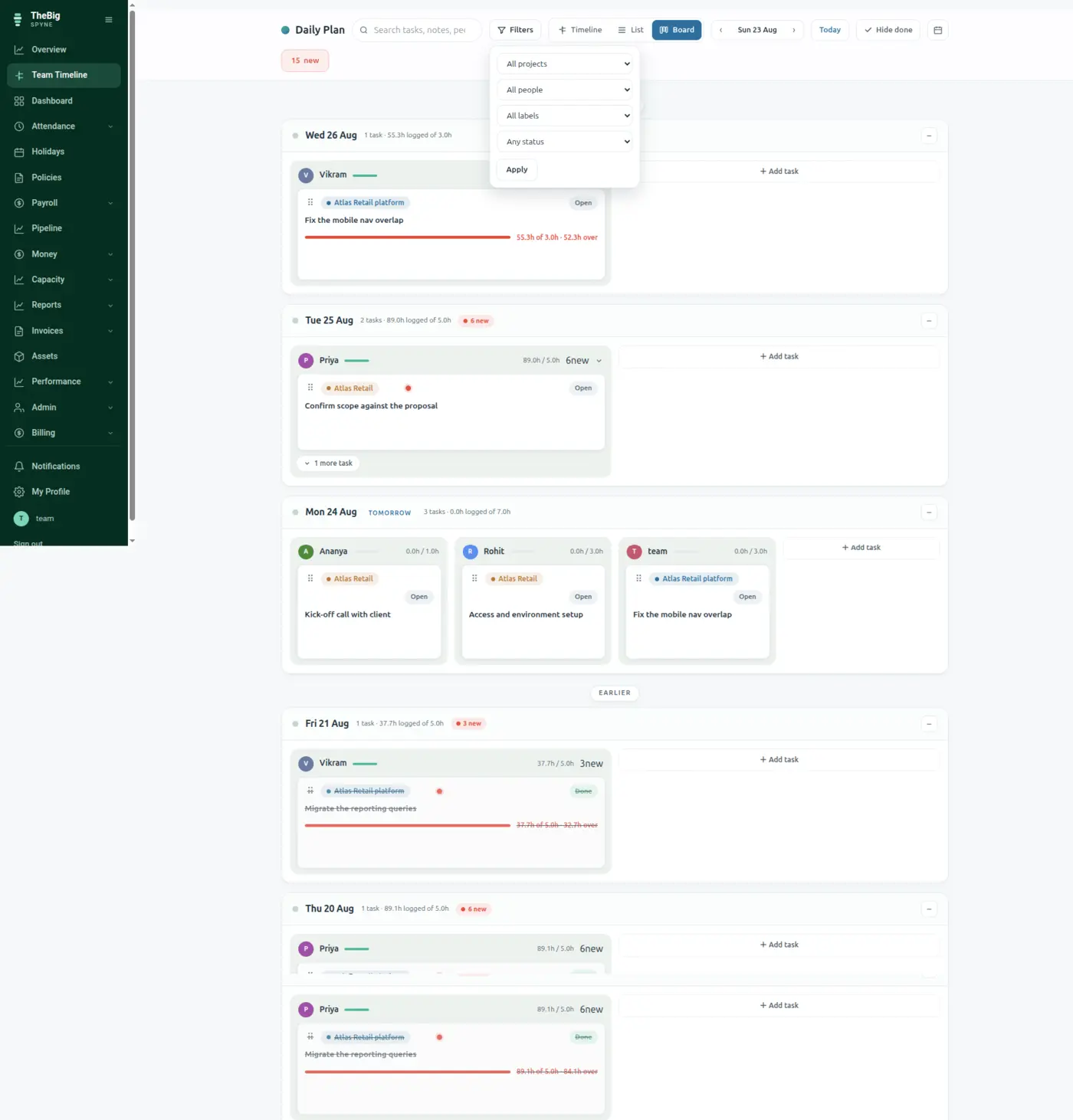
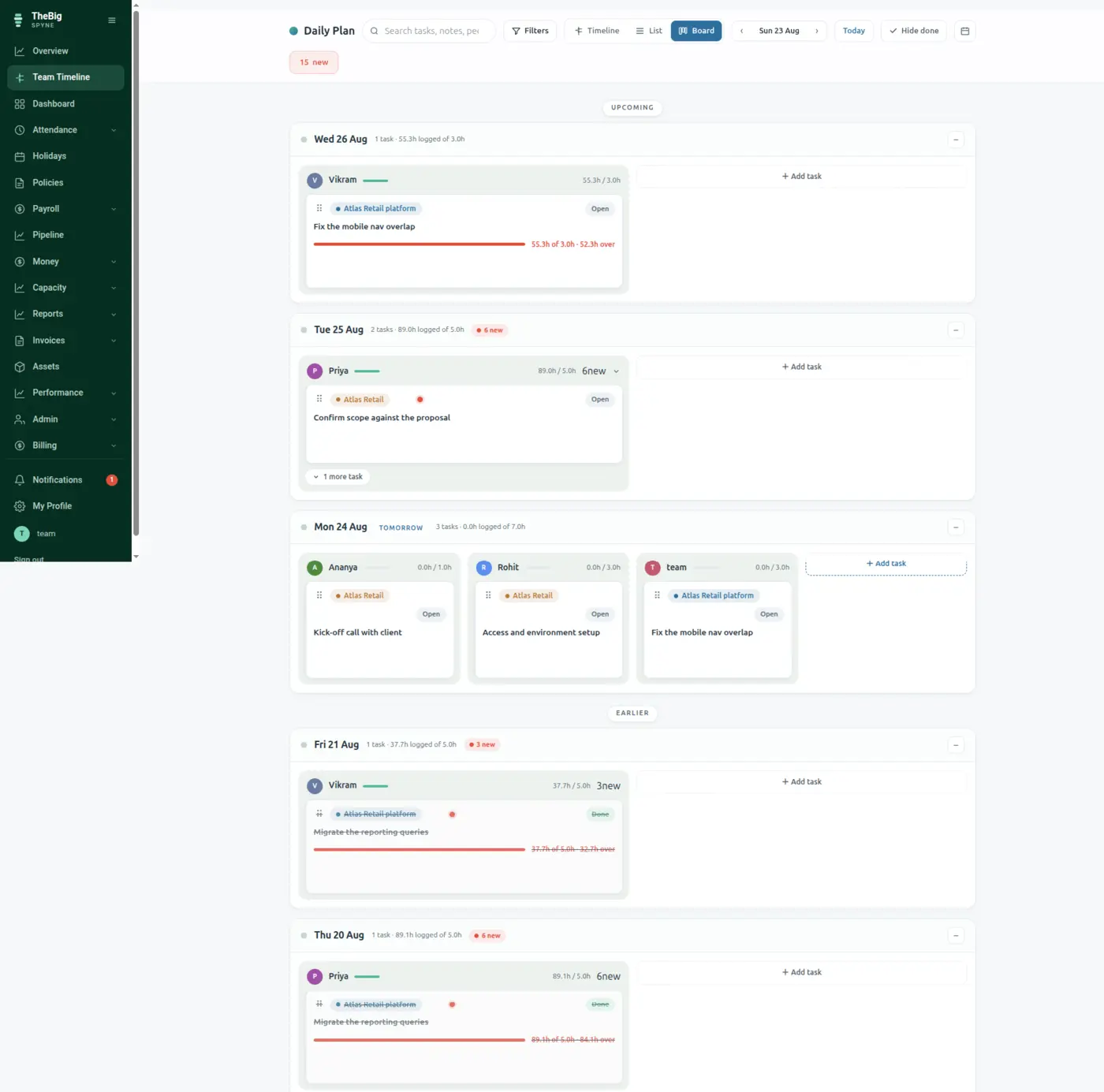
People log time on the task itself, beside the questions and notes about it. Overruns turn red on the Tuesday rather than at the retrospective — 7.0h against a 3.0h estimate is visible while you can still do something about it.
Carries forwardLogged hours per person per project — the denominator everything downstream uses.
The payslips issued this month are real money that left the company. Each person's pay, less the share covering their leave, is what there is to divide — not an hourly rate somebody typed into a spreadsheet.
Carries forwardIssued payslips are snapshots, so a margin computed today still holds next year.
Each person's cost is spread across the projects they logged hours to, in proportion to those hours. Hours nobody logged are reported as unlogged rather than quietly allocated — which is the single reason other tools' margins look healthier than yours.
Carries forwardA cost per project that updates itself when somebody gets a raise.
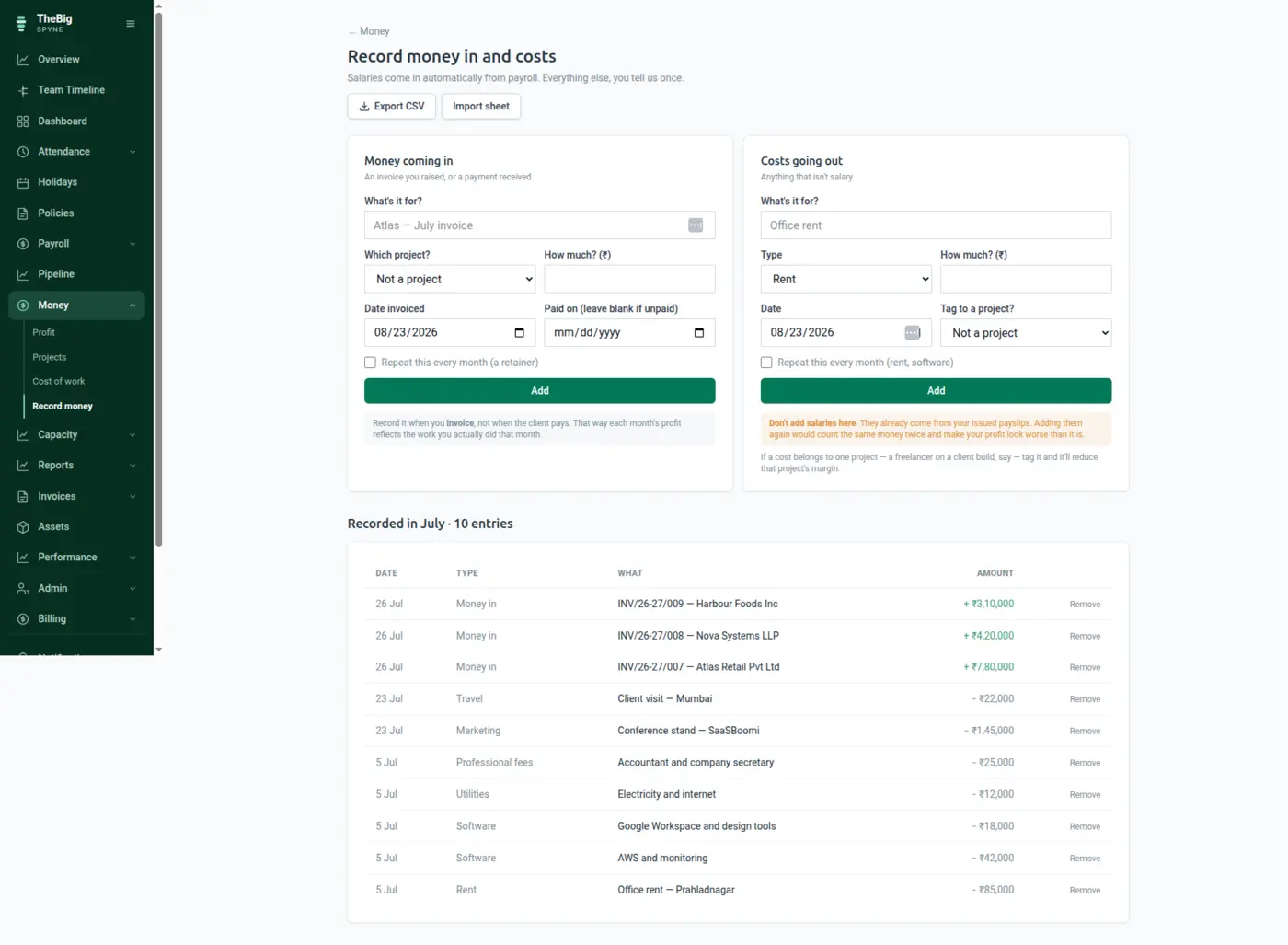
Revenue from the invoices you issued, cost from the payslips you paid. The next quote starts from a real number instead of a feeling, and the client you were about to take on more work for might turn out to be the one you should reprice.
Carries forwardFeeds straight back into what you quote — see the lead-to-invoice flow.
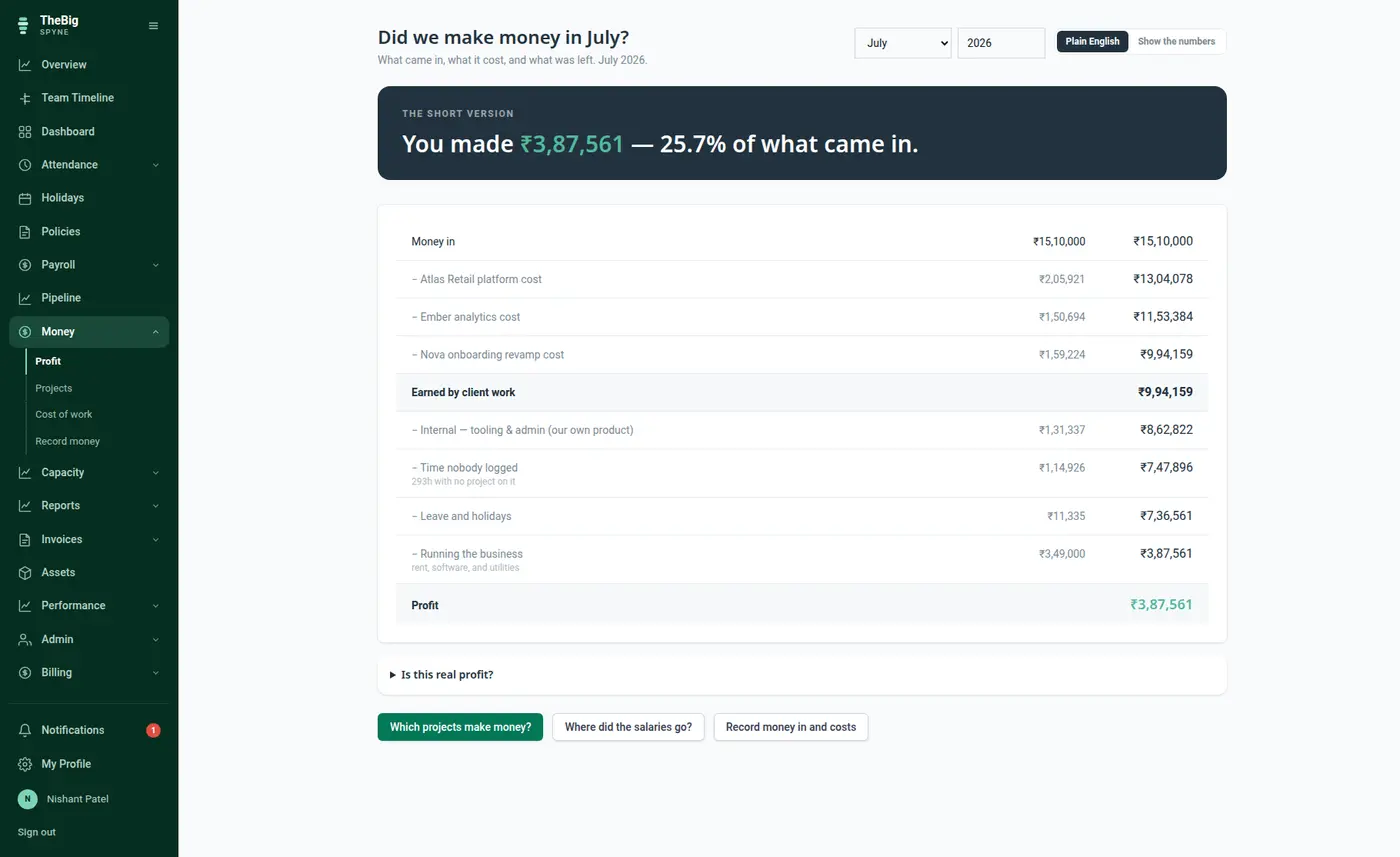
Every step above reads the record the step before it wrote. Nothing is exported, imported, re-keyed or reconciled — which is why the whole thing takes minutes rather than an afternoon.
Every one of these is a separate tool, a separate login and — almost always — a separate per-seat bill. Spyne is one price for the whole company.
| Instead of paying for | You get, on one record |
|---|---|
| A time-tracking tool | Hours logged on the task, against the project, beside the work itself. |
| A sprint board nobody updates after Tuesday | A daily plan that gets published and kept as a record. |
| The rate-card spreadsheet | Cost taken from the payslips you actually issued. |
| A separate profitability report | Margin per project and per client, from invoices and payroll. |
Every task carries estimated against logged hours. Over a few months that is the only honest input to "how long will this take" — and it feeds the capacity forecast directly.
A raise changes the cost of work from the month it takes effect, and not a month earlier. Last quarter's margin stays what it was.
Unlogged time is a reported number. You know how much of the picture to trust, which is more useful than a complete-looking one that is not.
The floor under the next quote is what the last comparable job cost, in money, from the same system that paid it.
Named, in case you want the detail — but you never have to assemble them yourself.
No, and that is the point. Cost comes from the payslips issued for the month, divided across projects by logged hours. There is no second set of numbers to keep in step with payroll, so there is nothing to drift.
They are reported as unlogged. They are not spread across projects, because spreading them invents a cost distribution nobody observed and makes every margin look better than it is. You get the honest partial picture and the size of the gap.
For a five-to-fifty person team, usually yes — daily plans, tasks, estimates, comments, attachments and time logs. It is not built to replace a large engineering org's issue tracker, and we would rather say so.
The share of someone's pay that covers their leave is taken out before the rest is divided across projects, so a month with a long holiday does not silently inflate what the client work cost.
Both. Projects roll up to the client they belong to, so a retainer with several projects under it margins as one relationship as well as several pieces of work.
Which is the reason the margin at the end of one flow can be computed from the payroll at the end of another.
CRM → invoice → paid
The enquiry goes into a CRM. The quote goes into a spreadsheet. The invoice goes into a billing tool. The margin goes nowhere at all, because joining those three is a weekend nobody has....
See the flow →Joining → working → leaving
Somebody joins and gets added to five places. They work for two years across three more. They leave, and half of it is never closed — the laptop, the access, the leave encashment nobody...
See the flow →Six tools → one
What a small business is really paying for when it runs on a stack of separate tools, and what a single record removes.
Read the argument →Thirty days free, no card. One click fills the trial with a realistic sample company so you can see the whole chain with data in it before entering any of your own.