Guide

Running payroll in India, without a payroll department.

What a company of five to fifty people actually has to get right — the deductions, the payslip, and the record-keeping that decides who is believed when somebody disputes a figure. Written for a founder doing this themselves.

Before anything else

This is a plain-English orientation, not tax advice. Thresholds, rates and slabs change, and several of them differ by state. Confirm the current numbers with your accountant before you rely on them — what follows is about the shape of the problem, which changes much more slowly than the rates do.

The four deductions

What comes off a salary, and why

EPF — Employees' Provident Fund A retirement fund. Both sides contribute 12% of basic plus dearness allowance, with a statutory wage ceiling many employers apply. Broadly compulsory once you reach 20 employees, and adoptable voluntarily below that. The employer's half is a real cost on top of the salary — which is why any honest cost-of-employment figure includes it.
ESI — Employees' State Insurance Medical cover for lower-paid employees. A small percentage from the employee and a larger one from the employer, for those under the wage ceiling in a notified area. Somebody crossing the ceiling mid-period generally stays covered to the end of that contribution period, which is the detail most spreadsheets get wrong.
Professional tax A state tax with state slabs — Gujarat, Maharashtra and Karnataka all differ. Deducted monthly and deposited by the employer. Small in rupees, and a common source of notices precisely because it is small enough to forget.
TDS on salary Income tax deducted at source, based on the employee's projected annual income and chosen regime. Most small companies work this out with their accountant once a year and adjust it across the months.
Gratuity (not a deduction) Payable to employees who complete five years, at roughly 15 days' wages per completed year. Nothing comes off the salary for it, but it accrues from day one — so it belongs in what a person costs, even though it does not appear on a payslip.
The document

What has to be on a payslip

The exact form is set by your state's Shops and Establishments rules, but the substance is consistent: an employee must be able to see what they earned, what came off, and what was left.

  • Identification Employer and employee, the employee's identifier, and the wage period.
  • Earnings, itemised Basic, HRA and every allowance shown separately rather than as one gross figure.
  • Every deduction, named EPF, ESI, professional tax, TDS, loan recovery — each on its own line.
  • Days Working days, days paid, and any loss of pay.
  • Net payable Usually in words as well as figures.
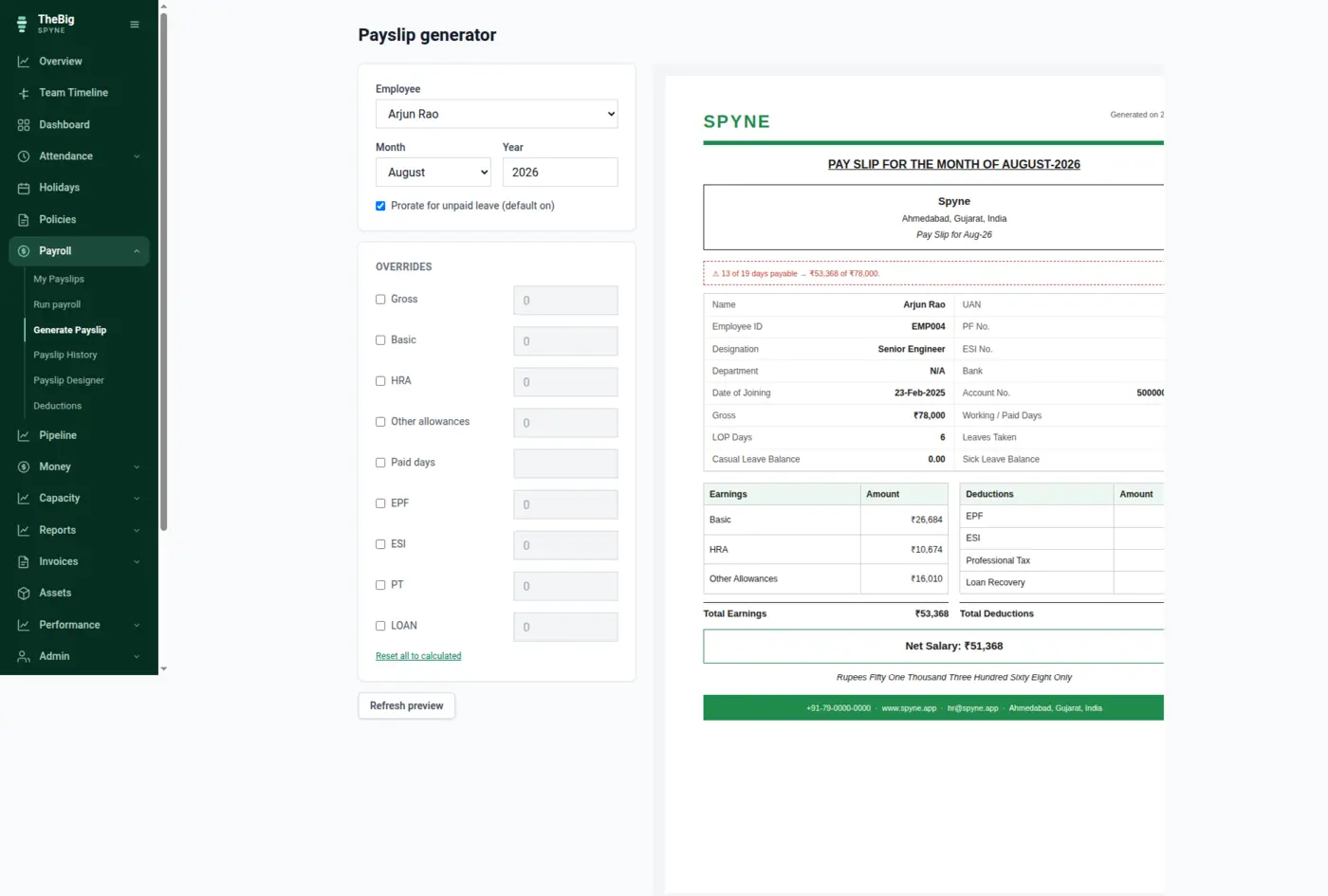
The payslip generator with employee and month selected, override fields, and a live payslip preview
The generator. Every figure is computed server-side; the browser only previews.
The part nobody warns you about

Three ways small-company payroll goes wrong

Not the rates. The rates are looked up once and mostly stay right. These are the failures that turn into an argument, and they are all about the record rather than the arithmetic.

History that recalculates

A spreadsheet with a salary column and payslip formulas rewrites the past every time somebody gets a raise. The payslip an employee downloads in March no longer matches the one they were emailed in September — and the version they were emailed is the one that counts.

Paid days that nobody can evidence

The deduction is challenged, the attendance was typed from memory by the person being asked about it, and there is nothing to look at. The number might be right; nobody can demonstrate that it is.

Line items that do not add up

Basic, HRA and allowances are each rounded independently and no longer sum to gross. One rupee out on a payslip costs more credibility than it does money — round the components and let allowances absorb the remainder.

How Spyne handles it

The rules are yours; the record is fixed.

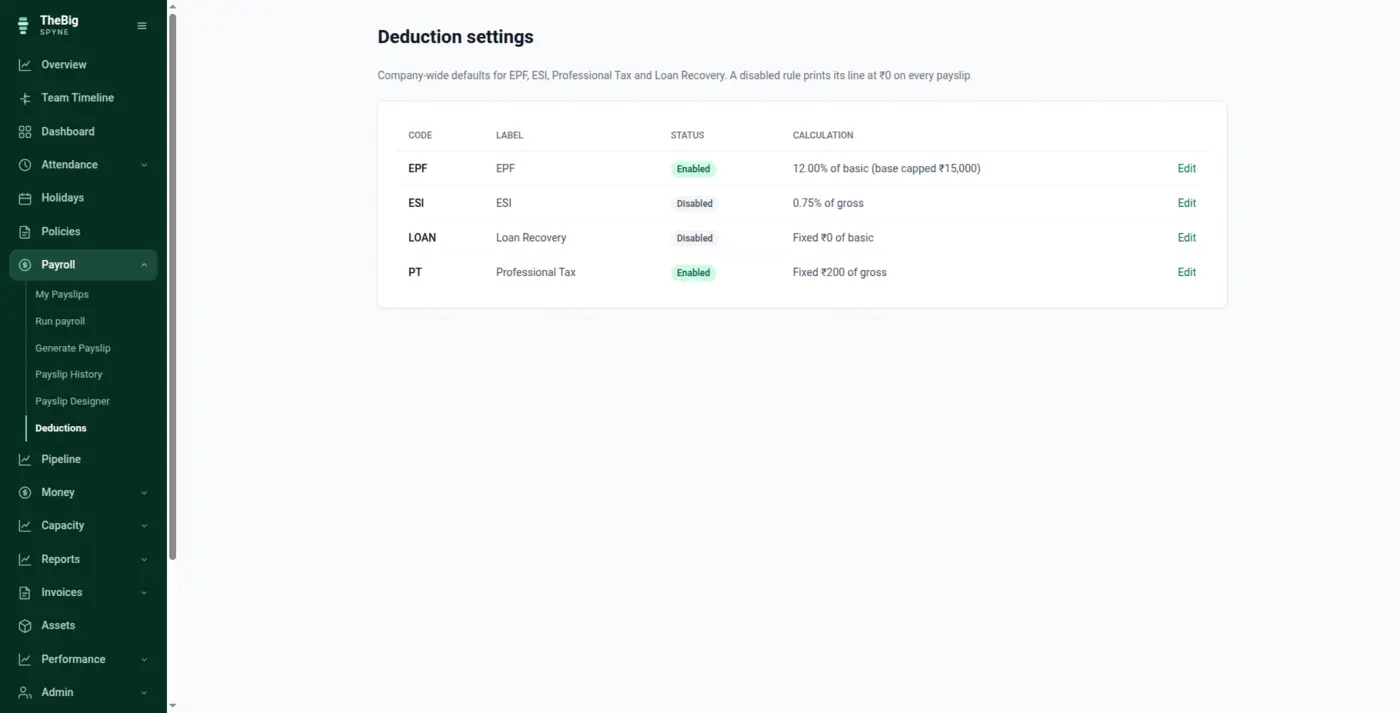
EPF, ESI and professional tax are configurable rules with their own caps and thresholds, because the numbers change and they differ by state. What is not configurable is what happens to a payslip once it is issued.

  • Issued payslips are snapshots Every figure stored on the row. A raise next April cannot rewrite last September.
  • Paid days come from evidenced attendance With the IP captured server-side at the punch.
  • Line items always reconcile Enforced by a test that runs across a wide range of gross values and paid-day ratios.
  • Corrections keep both versions A reissue needs a reason and sits beside the original.
The deduction settings screen listing EPF, ESI, professional tax and loan recovery rules
Deduction rules. Yours to set, applied the same way every month.
Questions

The ones we get asked

Is a payslip legally required in India?

Yes. Under the Payment of Wages Act and the state Shops and Establishments rules, an employer must give each employee a wage slip showing gross wages, every deduction and the net amount. The exact form varies by state; the substance does not.

When does EPF become compulsory?

Broadly, once an establishment reaches 20 employees. Below that it can be adopted voluntarily. The statutory contribution is 12% from the employee and 12% from the employer, calculated on basic plus dearness allowance, with a wage ceiling that many employers apply and some choose to exceed.

Who has to be covered by ESI?

Employees earning up to the ESI wage ceiling, in establishments over the applicable headcount, in a notified area. Contributions are a small percentage from the employee and a larger one from the employer. Somebody who crosses the ceiling mid-period usually stays covered until the end of that contribution period.

How is professional tax calculated?

It is a state tax with its own slabs, so it differs between Gujarat, Maharashtra, Karnataka and the rest. It is deducted monthly from salary and deposited by the employer.

How long do we have to keep payroll records?

Several years, and the exact period depends on which statute you are being asked under. The practical answer is longer than you think and in a form you can produce on request — which is why a spreadsheet that recalculates history is a genuine problem.

Rates and thresholds move. Where a number matters to a decision you are about to make, check it against the current notification or ask your accountant — we would rather send you to them than have you rely on a figure this page has not been updated for.

Run one month and see

Thirty days free. Set your deduction rules once, run a month against real attendance, and compare it with whatever you do today.